mercredi 10 novembre 2010

Will Android beat Symbian in Q4?

Gartner just published smartphone sales for Q3 2010 and as you can see below in the graphic below, Android is litterally exploding, while Nokia's market share is melting down.

If Android keeps this pace, and with the Christmas effect coming in, Android could very much overthrow Nokia at Q4 (or get to a very close tie), especially since Nokia is now the sole manufacturer of Symbian after recent news of Nokia taking control of the Symbian Foundation (but that, everybody expected it especially after SonyEricsson and Samsung abandonned Symbian)


Now we have to put things into prospective, market share is one thing, total sales is another. Total smartphone sales went from 41 million to 80.5 million on a year-on-year basis; so Nokia just didn't grow its smartphones sales as fast as Android: +61% for Nokia versus + 1326% (yes, that's correct) for Android.

So there are definitely two sides of the story:
- Nokia is still increasing its sales, especially of smartphones devices (+61% is a growth percentage many would love)
- But Nokia is definitely loosing ground to Android while iOS is stagnating (and Rim went from 21% to 15% market share)

Yes, Nokia has launched the N8, it's all over the country (France). I guess it will sell well, even if today we don't have any figures. But will it enable Nokia to resist the Android wave?? That's another story.

From a developper community stand point, this will surely do not help Nokia get more attention from developpers, read my previous post on why isn't OVI on top of mind for Zuckerberg.

vendredi 1 octobre 2010

Mobile OS war; Nokia's symbian losing 2 major supporters

In past few days, 2 major phone manufacturers, i.e. SonyEricsson (Sept 24th) and Samsung (Oct 1st); have announced that they will not longer support Symbian.

Per se it's not so surprising since SE is really struggling and Samsung has developped its Bada; and both are fully supporting Android!

But it's a serious drawback to Nokia who bought all remaining shares of Symbian in 2008 for €264 million; and looking at the competition coming, even opened the sources of Symbian back in February; hoping for more OEM and developers to use it.

While all the other manufacturers are leveraging the shared experience of Android and also developing their own OS for some markets; this leaves Nokia pertty much alone here. Can Symbian compete against Android in terms of speed of innovation and implementation; for the mass market? The worlds "speed" and "mass market" are critical here; especially since Android phones are starting to compete against Nokia's stronghold: the cheap phones in developing countries.

About the MeeGo, which is the continuation of the Maemo (remember the N900, one of Nokia's biggest failures); are consumers going to wait for it for long (nothing about this at recent Nokia World 2010)? Time is, as always, a critical factor.

But what is truly behind the OS war?
- Ability to innovate and bring those innovations to market, fast.
- Ability to attract developers; as we know that content is a key element of the smartphone business.

Something to follow very close!

jeudi 19 août 2010

Why is Nokia still struggling on the smartphone business?


In a recent article published in Zdnet  "Nokia rules the mobile phone world so why do we diss them in the US?" (read full article), the author Matthew Miller is wondering why do Americans have so much against Nokia. The comments from readers were also quite good and interesting.

But as may techies, they miss the point. It's not only an American thing, it's a worldwide trend (at least in developped countries), figures published do show it, Nokia is losing market shares in the smartphone business.


For having tried few hundred different devices for the past 6 years, I would definitely go with Matthew on numerous points, also shared by most readers who posted comments.

That is yes, Nokia phones have definitely a much better calling quality, yes they have a much better camera (on average, I must precise), and yes they have tons of cool features which are not to be added via an app.

But there's a major point many techies tend to follow. For many consumers, let's say the majority, what does really matter? It's a concept called "user friendliness" and a "wow" effect.

Few years ago, it was all about mp3 players. There were tons on the market, and many, many much better than the iPod. But guess what, iPod (and all its versions) made the revolution (and the income), and they still sell many despite the fact that most phones can do virtually the same. Now why would somebody buy an additional device to do something his one phone is doing? User friendliness, simplicity!!

I had N85 which I was using as a modem to connect on the internet while abroad with my laptop; great feature, but that required a lot of time in configuration (more than any normal person would spend). So not really a feature valuable to most consumers.

Now the day I had an iPhone in my hands (3 years ago), it was like "wow", so fluid, so easy and intuitive and can do so well the simple tasks I want to do. Yes camera is crappy, but I never expected my phone to replace my camera (and you can line up millions of pixels, you still won't even compare with plain cameras...). Putting content on it, nothing simpler, one cable, one software darn easy to use (a 5 year old could use it), that’s it ....

The point I'm trying to make is that yes, Nokia is making great phones; solid, reliable, full of tech stuff; but their “smartphones” are not as appealing to consumers as they were and don't address their needs; at least not in the real smartphone market (sorry, but for me a N95 is not a smartphone), and far not as much as they used to. Let’s also define what a “smartphone” is. For me, it’s a mobile device that can do a lot of multimedia things starting with Internet, can also call and have a bunch of communication features (social networks, maps, apps that help me where I am, like nearby movie theater with movies played there, etc.).

Lately, I tried to install Nokia maps on my N95, took me 2 hours to configure the darn account, ensure that my PC would recognize my N95, put the software, download the maps, install the maps; and finally when using it, after 10 meters, the navigation closed because the phone couldn't get connected (and yes, at the same spot I could get a perfect 3G signal and could connect to the Internet).... hardly a real smartphone (but I know, it's not a recent one, but still considered as a "smartphones" by people like Gartner when doing their stats). On iPhone, you press Map, and that’s it. Simple. Yes, less features, but guess what, when I’m lost, I don’t have minutes to spend configuring a phone!

I have tried a N8 over a month ago. Side to size even with an iPhone 3G (not even 3Gs), consumer lambda would still see the difference; starting with the touch sensitivity.... yes, it's basic, but darn hell important!

I also have a SE X10, Android. Touch sensitivity = same as iPhone, connectivity: super easy; but a bit more of a mess when it comes to apps and menu, but still much better than the Symbian interface.

What many said here in comments is quite significant of the issue Nokia faces. They said that after a while, you get used to the Symbian OS. Well, that's the problem. It's not the consumer who shall get used to the OS, it's the opposite!!

So that's why I have entittled this comment "is it really about technical specs", because it ain't!

Now I admit, I didn't test the Nokia N900. Could be a very slick device, I don't know. But this highlights the second issue with Nokia: how they sell their devices to consumers. Have you seen a Nokia ad lately? I for sure haven't. I see Apple, I see Samsung, I see HTC... but not Nokia; and I’m not in the US, but in France.

Actually when you talk to marketing people from Nokia, they will admit aspiring to Apple's user experience. I quote an article from Mobile Entertainment (june 1st 2010) "Nokia's head of global partner marketing Nick Malaperiman admits that the company has work to do to catch up with Apple's App Store in terms of user experience." (read full article)

Back 2 years ago, Nokia's EVP of Entertainment (at the time) Tero Ojanpera was saying "Nokia has been steadily repositioning itself from hardware manufacturer to “a next-generation entertainment company.” (read full article). What Nokia really lacks is meeting words with reality. Do you see Nokia as a media company. Lambda consumers sure don't.

So Nokia guys, you have the strength, you have the brains, you have a hell of a brand, you have the money (at least, you still do for now), think "outside the box"! I would even say "think outside the Finnish box" and you will really kick some butts!

That’s a personal opinion from a consumer who had few happy years with Nokia phones and is really expecting a lot from them.

And Mathew, would love to read your post once you’ll test the N8, truly.

mardi 17 août 2010

Google Android, Ovi, and the billing issue - why it's still an issue!!

Few days ago, Google reported discussing about integrating PayPal into its Android Market to allow consumers using their PayPal account to pay for contents.

Jolie O'Dell from Mashable summarizes the issue very well: "For many users, one of the biggest pain points in owning an Android device can be the experience of buying a non-free mobile app from the Android Market."

This summarizes very well the core issue about mobile entertainment: how do you  charge consumers and make money. Doing marketing is nice, showing off your brand and your services with cool applications is certainly helpfull and needed. But in the end, you need to make money out of it.

Besides iPhone, other "stores" are really lagging behind, including Ovi. Noticed they communicate on "downloads" and not on income?

As it has been proven over time that carrier billing is the best way to convert spontaneous purchases on the phone", and bluntly writes "What Google really needs to do is integrate carrier billing around the world to make it as painless as possible for consumers to click, pay and download applications" (make sure you read the comment from PhilipCohen" in this article)

So on one side, you have mobile stores with increasingly huge number of downloads (Android Market) but no income, and on the other side you have Mobile Operators with decreasing (that's an understatment) downloads on their own portals, but with the current most efficient billing.

Now you could think that guys like Nokia and Google are pretty smart guys, that they didn't wait for us to think about this. So why didn't they implement operator billing?

1. It's becoming sensitive grounds, as mobile operators have their own App strategy, which obviously competes directly against manufacturer's stores. See my post about Vodafone and Android....

2. Well, unlike credit cards and PayPal, operators are pretty darn expensive, they take a very large chunk of the revenues (30-50% average)! Of course operator payout is more efficient, but are they the one driving the traffic and the hype those days?

3. You know how many mobile operators there are out there. That means that many contracts, implementations... that's why even Nokia who started it a while ago with Ovi, still isn't there.

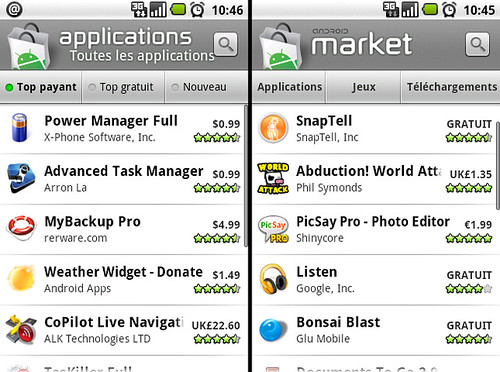
 On the left, an image (credit Ilogan) very similar to what I saw on my SE X10 today. I'm in France, but apps are listed in US dollars, UK Pounds or in Euros (of free "Gratuit")... go wonder why nobody buys anything!!


The issue is that if nobody agrees or find suitable solutions, there will be no eCommerce on mobiles, maybe advertisement, but advertisement for the "real world"; and advertisers will get tired very soon, once the "hype" is over!

Fortunately, there's still the iPhone; where we can still make some income!!

My bet: the way things are currently evolving, I'm placing a bet on credit card issuers like Visa or MasterCard.... But operators still have a good cards in their hands, but they shall use them, and fast!